
Use Of 3kw, 5kw, 7.5kw, And 10kw Hybrid Solar Inverters
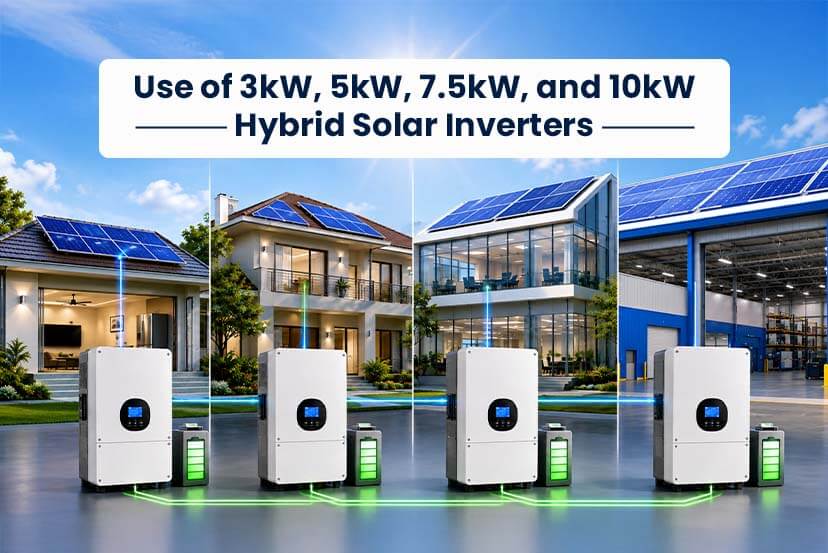
A hybrid solar inverter is an important component of a solar power system that combines solar generation, battery storage, and grid electricity in a single setup. Unlike a conventional solar inverter, a hybrid inverter can manage electricity from multiple sources and automatically direct power where it is needed. This makes it useful for homes, offices, shops, small businesses, and commercial applications.
The right inverter capacity depends on electricity consumption, connected load, solar panel capacity, battery size, and backup requirements. Among the commonly used options, 3kW, 5kW, 7.5kW, and 10kW hybrid solar inverters cover a wide range of residential and commercial requirements.
Also Read: Top 10 Solar Inverter Manufacturers In India 2026
What Is a Hybrid Solar Inverter?
A hybrid solar inverter is a device that converts the DC electricity generated by solar panels into AC electricity used by electrical appliances. At the same time, it can control battery charging and discharging and coordinate power supplied by the electricity grid.
A typical hybrid solar system works in the following way:
Solar Panels – Hybrid Inverter – Electrical Loads
The inverter can also connect with:
Battery Storage ↔ Hybrid Inverter ↔ Grid
When solar energy is available, the system can power connected appliances directly. Excess solar energy can be stored in batteries for later use. When solar generation and battery power are insufficient, the system can draw electricity from the grid, depending on the configuration.
Why Choose Different Hybrid Inverter Capacities?
Not every property has the same electricity requirements. A small home may need only a few kilowatts of inverter capacity, while a larger home, office, retail outlet, or small industrial facility may require considerably more.
The capacity of a hybrid inverter indicates the maximum AC power it can generally deliver, subject to the manufacturer’s specifications.
| Hybrid Inverter | Typical Application | Suitable For |
| 3kW | Small-scale power backup | Small homes, apartments, basic loads |
| 5kW | Medium residential power | Larger homes, offices, shops |
| 7.5kW | Higher power requirements | Large homes, offices, commercial establishments |
| 10kW | High-capacity power management | Large homes, businesses, and commercial applications |
Actual suitability depends on appliance load, solar PV capacity, battery configuration, inverter specifications, and local installation requirements.
Also Read: Top 10 Battery Energy Storage Systems (BESS) Manufacturers in India 2026
Use of a 3kW Hybrid Solar Inverter
A 3kW hybrid solar inverter is generally suitable for properties with moderate electricity consumption and a limited number of high-power appliances. It can provide solar power during the day and battery backup when solar generation is unavailable.
Common Applications of a 3kW Hybrid Inverter
A 3kW hybrid inverter can be considered for:
- Small residential properties
- Apartments and compact homes
- Small offices
- Retail shops
- Home-based businesses
- Basic lighting and appliance backup
- Small solar-plus-storage installations
Appliances That Can Be Supported
Depending on their individual power ratings and whether they operate simultaneously, a 3kW system may support loads such as:
- LED lights
- Fans
- Television
- Computers and laptops
- Wi-Fi routers
- Refrigerators
- Small kitchen appliances
- Small water pumps
However, high-power appliances such as air conditioners, electric geysers, induction cooktops, and heavy motors can significantly increase the required inverter capacity.
Benefits of a 3kW Hybrid Inverter
A 3kW hybrid inverter can offer:
- Lower initial system cost
- Solar power generation and battery backup
- Reduced dependence on grid electricity
- Automatic power-source management
- Suitable capacity for essential household loads
- Compact installation requirements
Use of a 5kW Hybrid Solar Inverter
A 5kW hybrid solar inverter provides greater power capacity and is often suitable for medium-sized homes and businesses with higher electricity consumption.
It can manage a larger number of appliances simultaneously than a 3kW system, provided the combined running and starting loads remain within the inverter’s specifications.
Common Applications of a 5kW Hybrid Inverter
A 5kW hybrid inverter can be used for:
- Medium and large residential homes
- Independent houses
- Small offices
- Retail stores
- Clinics
- Small workshops
- Home offices
- Small commercial establishments
Typical Loads
Depending on the system design, a 5kW inverter can support combinations of:
- Lights and fans
- Refrigerators
- Computers
- TVs
- Washing machines
- Water pumps
- Kitchen appliances
- Selected air-conditioning loads
- Other household or office equipment
The exact combination should be calculated based on the rated power and starting current of each appliance.
Why Use a 5kW Hybrid Solar Inverter?
The main advantage is the balance between capacity and cost. It can provide enough power for a wider range of appliances while retaining the benefits of battery storage and solar energy.
It is particularly useful when the user wants to operate essential appliances during power outages without relying entirely on a generator.
Use of a 7.5kW Hybrid Solar Inverter
A 7.5kW hybrid solar inverter is designed for applications requiring more power than a typical residential 5kW system can provide. It can be considered for large homes and small-to-medium commercial applications.
Common Applications
A 7.5kW hybrid inverter can be suitable for:
- Large residential properties
- Villas
- Large home offices
- Small commercial buildings
- Retail outlets
- Restaurants and cafés
- Clinics
- Small workshops
- Offices with multiple electrical loads
Loads It Can Support
Depending on the system design, a 7.5kW inverter may support combinations of:
- Multiple fans and lighting circuits
- Refrigerators and freezers
- Computers and networking equipment
- Water pumps
- Kitchen equipment
- Multiple air-conditioning units
- Office equipment
- Selected machinery with suitable starting characteristics
For motor-driven equipment, the inverter’s surge capacity and motor-starting capability should be checked before installation.
Benefits of a 7.5kW Hybrid Inverter
A 7.5kW hybrid system can provide:
- Higher available power
- Greater backup capability
- Better support for multiple loads
- Solar and battery integration
- Reduced grid dependency
- Greater flexibility for expanding energy requirements
Use of a 10kW Hybrid Solar Inverter
A 10kW hybrid solar inverter is suitable for applications with relatively high electricity consumption. It can be used in larger residential properties as well as commercial environments, depending on the inverter’s electrical configuration.
Common Applications of a 10kW Hybrid Inverter
Typical applications may include:
- Large homes and villas
- Large offices
- Retail establishments
- Restaurants
- Clinics and healthcare facilities
- Small commercial buildings
- Workshops
- Small manufacturing or processing facilities with compatible loads
What Can a 10kW Hybrid Inverter Power?
With appropriate system design, a 10kW inverter can support a larger combination of:
- Lighting systems
- Fans
- Refrigeration equipment
- Computers and office equipment
- Water pumps
- Kitchen appliances
- Air-conditioning systems
- Selected commercial equipment
- Other compatible electrical loads
For commercial or industrial equipment, the starting current, phase configuration, duty cycle, and power factor should be considered rather than selecting an inverter based only on the total running wattage.
Benefits of a 10kW Hybrid Solar Inverter
A 10kW system can provide:
- Higher power-handling capability
- Greater solar utilisation
- Larger battery-backup potential
- Reduced reliance on grid electricity
- Support for larger electrical loads
- Greater flexibility for commercial applications
Also Read: Top 10 Solar Panel Companies in India (2025-2026)
3kW vs 5kW vs 7.5kW vs 10kW Hybrid Solar Inverter
Choosing between these capacities requires understanding the difference in their intended applications.
| Feature | 3kW | 5kW | 7.5kW | 10kW |
| Capacity | Lower | Medium | High | Higher |
| Small home | Excellent | Suitable | Usually more than required | Usually more than required |
| Large home | Limited | Suitable | Excellent | Suitable |
| Small office/shop | Suitable | Excellent | Excellent | Suitable |
| Larger commercial use | Limited | Moderate | Suitable | Excellent |
| Battery backup potential | Lower | Medium | High | Higher |
| Initial investment | Lower | Moderate | Higher | Higher |
| Best suited for | Essential loads | Residential + small business | High-demand applications | Larger residential/commercial loads |
Important: These are general guidelines, not fixed load limits. The final inverter size should be selected using an electrical load calculation and the manufacturer’s specifications.
How to Choose the Right Hybrid Solar Inverter Capacity?
Selecting the correct inverter is more than simply adding up the wattage of appliances. Several factors should be considered.
1. Calculate Your Connected Load
Prepare a list of all appliances and electrical equipment you want the solar system to operate.
For example:
Load = Number of appliances × Rated power of each appliance
Then calculate which appliances are expected to operate simultaneously.
2. Consider Peak Load
Some equipment consumes considerably more power when it starts. Motors, compressors, pumps, and certain air-conditioning systems can have high starting or surge requirements.
Therefore, check both:
- Running power
- Starting/surge power
3. Determine Your Solar Panel Capacity
The inverter should be compatible with the proposed solar PV capacity. Check the inverter’s:
- Maximum PV input power
- MPPT voltage range
- Maximum PV input current
- Number of MPPTs
- Maximum DC voltage
The permitted solar oversizing ratio also varies by model.
4. Select the Battery Size
Battery capacity determines how long selected loads can operate when solar power is unavailable.
A simplified calculation is:
Battery Energy Required (kWh) ≈ Load (kW) × Backup Time (hours)
The actual battery size should account for usable battery capacity, depth of discharge, inverter efficiency, temperature, and other system losses.
5. Check Single-Phase or Three-Phase Requirements
Small residential systems are commonly single-phase, while larger commercial installations may require three-phase equipment.
Always confirm whether the inverter supports the electrical configuration of the property.
6. Consider Future Expansion
If electricity consumption is expected to increase, selecting a system with suitable expansion or parallel-operation capabilities can prevent the need for an entirely new inverter later.
Advantages of Using a Hybrid Solar Inverter
Hybrid solar inverters provide several benefits compared with conventional grid-tied or standalone inverter systems.
Solar Energy Utilisation
The inverter converts solar electricity into usable AC power and can coordinate solar generation with household or commercial loads.
Battery Backup
Excess solar energy can be stored in compatible batteries and used later, including during power outages.
Reduced Grid Dependence
Using solar power and stored energy can reduce the amount of electricity purchased from the grid.
Automatic Power Management
Depending on the model and configuration, the inverter can automatically manage solar, battery, grid, and backup loads.
Better Energy Flexibility
Users can configure systems according to their electricity consumption, backup requirements, and solar generation.
Monitoring and Energy Management
Many modern hybrid inverters include digital monitoring through displays or mobile applications, allowing users to track solar generation, battery status, consumption, and grid power.
3kW, 5kW, 7.5kW or 10kW: Which One Should You Choose?
There is no universal best capacity. The correct choice depends on the property’s load profile.
- Choose 3kW if you primarily need essential household loads and moderate backup.
- Choose 5kW if you have a medium-sized home or small business with several appliances operating simultaneously.
- Choose 7.5kW if your property has higher electricity consumption and multiple high-demand appliances.
- Choose 10kW if you need to manage larger residential or commercial loads and require greater solar and battery capacity.
The best approach is to perform a detailed load assessment before purchasing the inverter.
Factors to Check Before Buying a Hybrid Solar Inverter
Before purchasing a 3kW, 5kW, 7.5kW, or 10kW hybrid solar inverter, check the following specifications:
- Rated AC output power
- Maximum PV input power
- MPPT voltage range
- Maximum PV input current
- Battery voltage compatibility
- Battery chemistry compatibility
- Maximum charging and discharging current
- Surge capacity
- Single-phase or three-phase compatibility
- Grid and backup output configuration
- IP rating
- Operating temperature range
- Communication and monitoring options
- Warranty
- Local installation and service support
- Applicable electrical and safety standards
Installation and Safety Considerations
A hybrid solar inverter should be installed by a qualified solar or electrical professional. Correct system design is important for safe and reliable operation.
The installation should consider:
- Proper inverter location and ventilation
- Correct cable sizing
- Appropriate DC and AC protection
- Earthing and surge protection
- Battery safety
- Solar panel string configuration
- Proper isolation and switching
- Grid connection requirements
- Manufacturer installation instructions
Incorrect sizing or installation can reduce system efficiency and may create electrical safety risks.
Conclusion
3kW, 5kW, 7.5kW, and 10kW hybrid solar inverters serve different energy requirements. A 3kW inverter can be suitable for smaller homes and essential loads, while a 5kW system offers greater flexibility for medium-sized homes and small businesses. A 7.5kW inverter is appropriate for higher-demand residential and commercial applications, while a 10kW hybrid inverter can handle substantially larger loads when correctly designed. If you’re looking to procure solar equipment and establish a solar power system, commercial or residential, then Moglix Business is the one-stop destination to partner with.
The right choice should be based on actual electricity consumption, peak load, solar panel capacity, battery requirements, phase configuration, and future energy needs rather than inverter capacity alone. A properly sized hybrid solar inverter can help maximise solar utilisation, provide battery backup, and reduce dependence on conventional grid electricity.


 Back
Back