
Benefits and Types of Cellular Lightweight Concrete (CLC)
Benefits and Types of Cellular Lightweight Concrete (CLC)
The construction industry is constantly evolving to meet the demands of sustainability, cost efficiency, and faster project completion. One innovative material that has gained significant popularity in recent years is Cellular Lightweight Concrete (CLC). Known for its lightweight properties, thermal insulation, and versatility, CLC is increasingly being used in residential, commercial, and industrial construction projects.
Businesses and industries requiring bulk procurement and looking to buy cement in bulk at the most reasonable prices, then Moglix Business is the right platform to procure effortlessly. Through this blog, understanding the benefits and types of Cellular Lightweight Concrete can help you make informed decisions for your next construction project.
What Is Cellular Lightweight Concrete (CLC)?
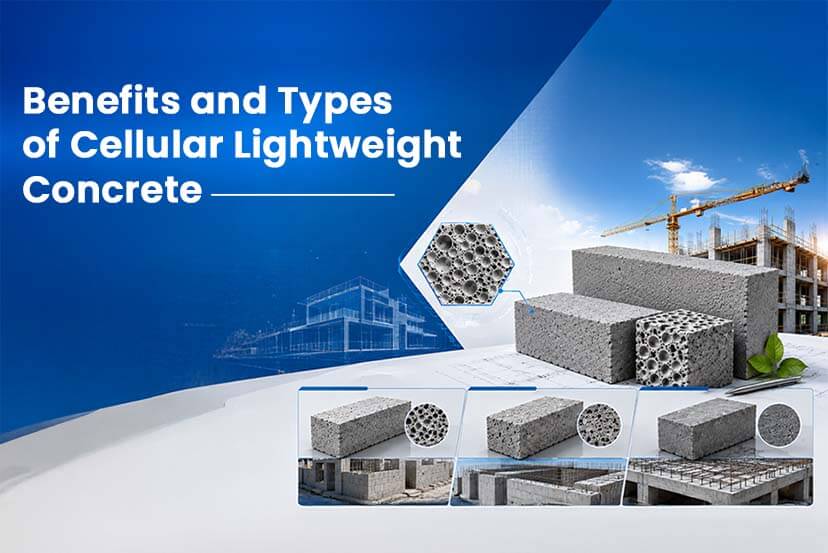
Cellular Lightweight Concrete (CLC) is a cement-based material that contains millions of uniformly distributed air bubbles created using a foaming agent. These air voids significantly reduce the density of the concrete while maintaining adequate strength for various construction applications.
Unlike conventional concrete, CLC is lightweight, easy to handle, and offers excellent insulation properties. It is produced by mixing cement, water, sand (optional), and a pre-formed foam generated through specialized equipment. The density of CLC generally ranges from 300 kg/m³ to 1800 kg/m³, depending on the intended application.
How Is CLC Concrete Made?
The manufacturing process of Cellular Lightweight Concrete involves the following steps:
- Preparation of cement slurry using cement, water, and sand.
- Generation of stable foam using a foaming agent.
- Mixing the foam with the slurry to create air-filled concrete.
- Pouring the mixture into molds or directly into construction areas.
- Curing the concrete for strength development.
The trapped air bubbles create a lightweight structure while maintaining sufficient durability and workability.
What are the Types of Cellular Lightweight Concrete?
CLC is classified primarily based on its density and intended applications.
1. Low-Density CLC (300–800 kg/m³)
This type of CLC contains a high volume of air voids and is mainly used where structural strength is not the primary requirement.
Applications:
- Roof insulation
- Void filling
- Thermal insulation layers
- Trench filling
- Soundproofing systems
Benefits:
- Extremely lightweight
- Excellent thermal insulation
- Reduced dead load on structures
2. Medium-Density CLC (800–1200 kg/m³)
Medium-density CLC provides a balance between strength and insulation properties.
Applications:
- Non-load-bearing walls
- Partition blocks
- Wall panels
- Building infill applications
Benefits:
- Good compressive strength
- Improved fire resistance
- Better sound insulation
3. High-Density CLC (1200–1800 kg/m³)
High-density CLC offers greater strength and durability while remaining lighter than conventional concrete.
Applications:
- Load-bearing walls
- Structural elements
- Floor screeds
- Precast components
Benefits:
- Enhanced structural performance
- Reduced overall building weight
- Easier handling and transportation
Benefits of Cellular Lightweight Concrete
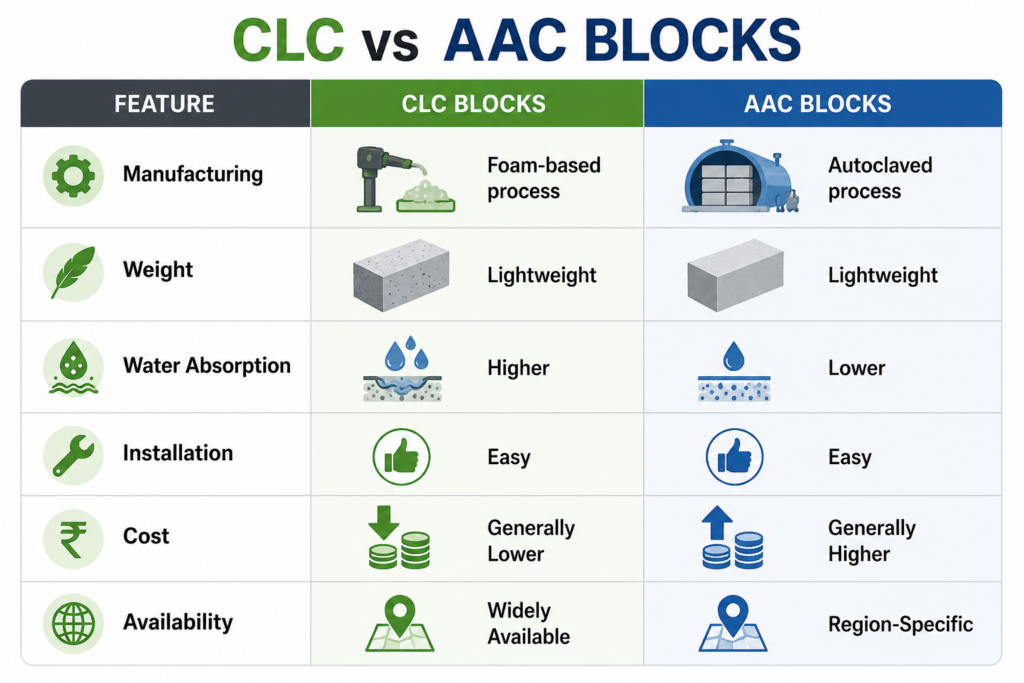
CLC offers numerous advantages over traditional concrete and masonry materials.
1. Lightweight Construction Material
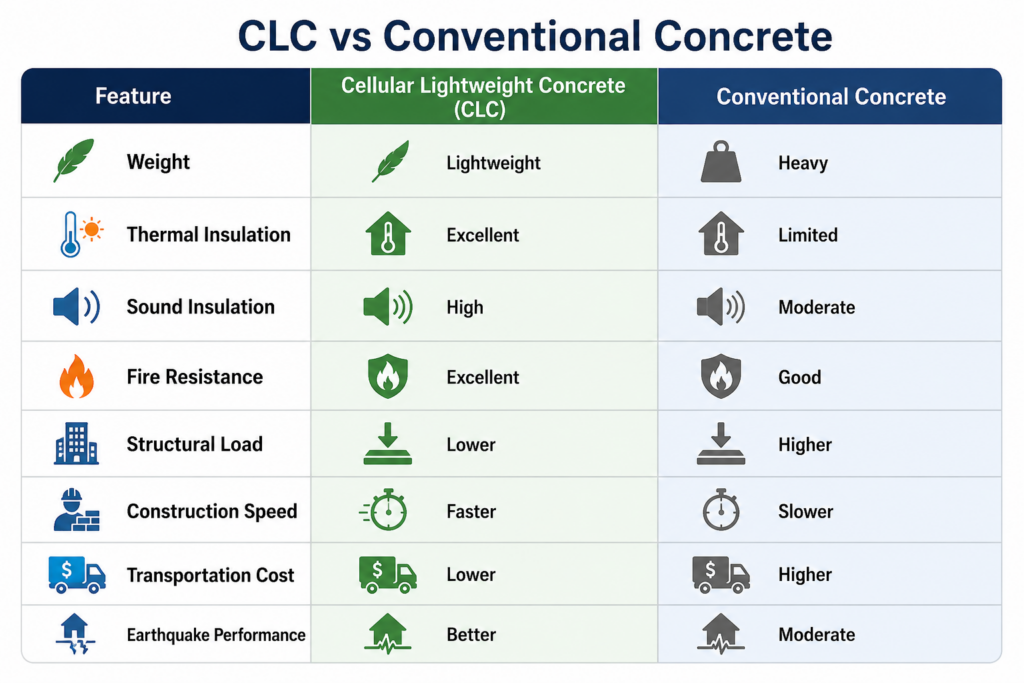
The most significant advantage of CLC is its low density. It can weigh up to 80% less than conventional concrete, reducing structural loads and foundation requirements.
Impact:
- Lower dead load
- Reduced steel consumption
- Cost savings in structural design
2. Excellent Thermal Insulation
The air bubbles trapped within CLC act as natural insulators, reducing heat transfer through walls and roofs.
Benefits:
- Lower indoor temperatures
- Reduced energy consumption
- Improved comfort in buildings
This makes CLC particularly suitable for regions with extreme temperatures.
3. Superior Sound Insulation
CLC effectively absorbs sound due to its porous structure.
Suitable For:
- Residential apartments
- Schools
- Hospitals
- Commercial complexes
- Recording studios
Its soundproofing capability improves indoor comfort and privacy.
4. Fire Resistance
Cellular Lightweight Concrete exhibits excellent fire-resistant properties.
Advantages:
- Non-combustible material
- Slows fire spread
- Protects structural elements during fire incidents
Many CLC blocks can withstand several hours of fire exposure without significant damage.
5. Environmentally Friendly
CLC is considered a sustainable construction material.
Eco-Friendly Features:
- Reduced raw material consumption
- Lower transportation emissions
- Minimal construction waste
- Potential use of industrial by-products
Its lightweight nature contributes to a lower overall carbon footprint.
6. Easy Workability
CLC can be easily cut, drilled, shaped, and installed using standard construction tools.
Benefits:
- Faster construction
- Simplified installation
- Reduced labor requirements
This flexibility makes it ideal for customized construction projects.
7. Reduced Structural Load
Because of its lower weight, CLC decreases the load imposed on foundations, columns, and beams.
Result:
- Smaller foundation requirements
- Lower reinforcement costs
- Increased design flexibility
This benefit is especially valuable in high-rise buildings.
8. Cost-Effective Construction
Although the initial production process may require specialized equipment, CLC often reduces overall project costs.
Cost Savings Come From:
- Lower transportation expenses
- Reduced labor costs
- Faster construction timelines
- Smaller structural components
These factors contribute to improved project economics.
9. Improved Earthquake Resistance
Lighter buildings experience lower seismic forces during earthquakes.
Benefits:
- Reduced structural stress
- Enhanced building safety
- Better seismic performance
CLC is therefore suitable for construction in earthquake-prone regions.
10. Moisture and Pest Resistance
Properly manufactured CLC offers resistance against moisture penetration, termites, and other pests.
Advantages:
- Increased durability
- Lower maintenance requirements
- Longer service life
Applications of Cellular Lightweight Concrete
CLC is widely used across various construction sectors.
Residential Construction
- Houses
- Apartments
- Villas
- Boundary walls
Commercial Buildings
- Office complexes
- Shopping malls
- Hotels
- Educational institutions
Industrial Projects
- Warehouses
- Factories
- Industrial flooring
Infrastructure Projects
- Road embankments
- Bridge approaches
- Utility trench filling
Precast Construction
- Wall panels
- Blocks
- Partition systems
Understand the Challenges of CLC Concrete
Despite its numerous advantages, CLC has some limitations.
Lower Strength at Low Densities: Very lightweight CLC may not be suitable for structural applications.
Specialized Production Equipment: Foam generators and mixing equipment are required.
Proper Quality Control Needed: Uniform foam distribution is essential to achieve consistent performance.
Curing Requirements: CLC requires proper curing to attain optimal strength and durability.
Best Practices for Using CLC
To maximize the performance of Cellular Lightweight Concrete:
- Use high-quality foaming agents.
- Maintain proper mix proportions.
- Ensure uniform foam distribution.
- Follow recommended curing procedures.
- Select density based on application requirements.
- Conduct regular quality testing.
These practices help achieve reliable and durable construction outcomes.
Conclusion
Cellular Lightweight Concrete (CLC) has emerged as a versatile and sustainable alternative to conventional concrete. Its lightweight nature, excellent thermal and acoustic insulation, fire resistance, and cost-saving advantages make it an ideal choice for modern construction.
From roof insulation and partition walls to structural applications and infrastructure projects, the various types of CLC cater to diverse construction needs. By understanding the benefits and selecting the appropriate density for specific applications, builders and contractors can enhance efficiency, reduce costs, and contribute to more sustainable building practices.
Top 10 Cement Manufacturing Companies in India 2026: Latest Ranking with Prices and Features
Top 10 Cement Manufacturing Companies in India 2026: Latest Ranking with Prices and Features
India’s construction industry is booming, from housing and highways to metros and airports, and demand for quality cement is higher than ever. Whether you’re building a home, investing in infrastructure, or searching for the best cement in India, choosing the right brand matters for strength, durability, and cost-effectiveness.
Every business and enterprises to buy the best cement manufactured by reliable and trustworthy brands to enhance the overall performance and safety of construction. At Moglix, you can procure cement in bulk from top brands at the most competitive prices. Therefore, in this blog, we’ve compiled a complete and informative guide on the top 10 cement companies in India in 2026, prices, features, and more.
Top Cement Industry Trends in India (2026)
1. Infrastructure-Led Growth
Government investments in highways, railways, metros, airports, and smart cities are driving strong cement demand.
2. Rising Housing Demand
Affordable housing and urban residential projects continue to boost cement consumption, with housing accounting for over 55% of total demand.
3. Capacity Expansion
Major manufacturers such as UltraTech Cement, Ambuja Cements, and Shree Cement are expanding production capacity to meet growing demand.
4. Green Cement Adoption
Manufacturers are increasingly investing in low-carbon cement, renewable energy, and waste heat recovery systems to meet sustainability goals.
5. Growth of Blended Cement
Demand for PPC, PSC, and composite cement is rising due to better durability and lower environmental impact.
Why Choose the Right Cement Brand?
Selecting the best cement affects:
- Structural strength
- Durability and longevity
- Workability and finish
- Cost efficiency
- Environmental impact
Good quality cement ensures better resistance to weather, cracking, and improves the overall safety of structures.
Top 10 Cement Companies in India 2026
Here’s the latest ranking based on market presence, production capacity, and brand reputation:
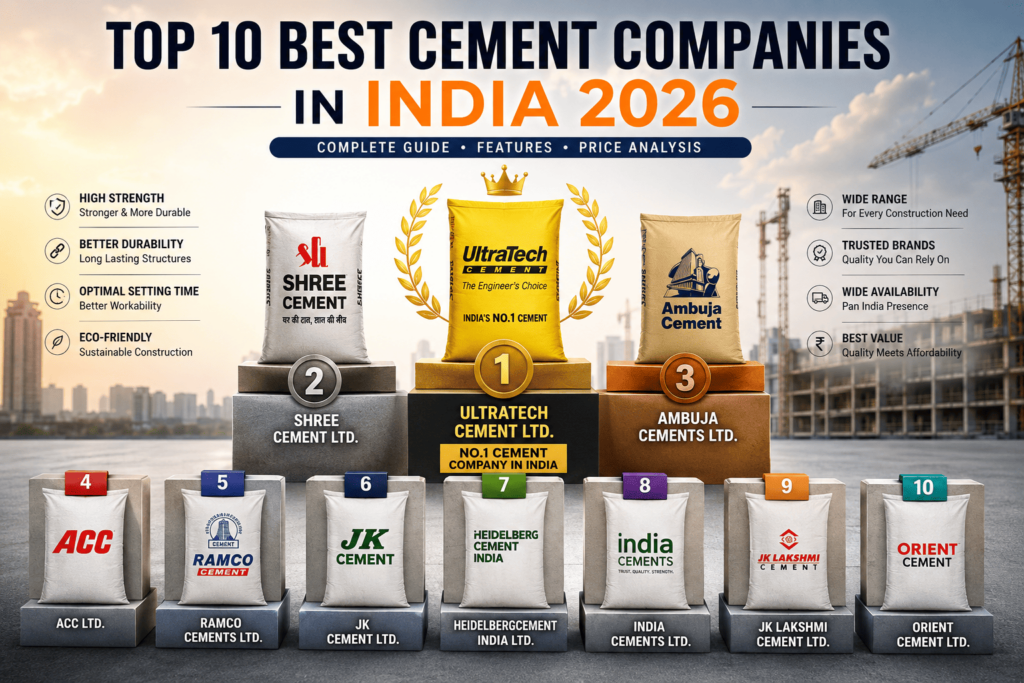
These brands dominate the Indian cement space, with wide distribution, strong quality control, and excellent technical specifications.
Comprehensive Information About The Best Cement Companies In India 2026
Based on the latest data and peer review, we have curated the list of the best cement in indian, while elaborating their features and price range. Let’s have a quick look at them:
1. UltraTech Cement Ltd. – No. 1 Cement in India
UltraTech Cement is the undisputed No. 1 cement in India and the largest cement manufacturer in the country by production capacity. It is part of the Aditya Birla Group and operates more than 23 integrated plants, 30+ grinding units, and hundreds of ready-mix concrete plants across India. UltraTech dominates the market in both urban infrastructure projects and rural housing, making it the first choice for highways, bridges, metro rail, and premium residential buildings.
Technical Specifications
| Specification | Performance |
| Compressive Strength | High |
| Setting Time | Standard |
| Durability | Excellent |
| Workability | Excellent |
| Crack Resistance | High |
| Applications | RCC, Infrastructure, High-Rise Buildings |
Approx Pricing (Regional Price Analysis 2026)
| Region | Price/Bag |
| North India | ₹440–₹460 |
| South India | ₹430–₹450 |
| West India | ₹445–₹465 |
| East India | ₹435–₹455 |
2. Shree Cement Ltd.
Shree Cement is one of the fastest-growing cement companies in India and a strong competitor in the top 10 cement companies in India. Known for its highly efficient manufacturing plants and low production costs, Shree Cement supplies premium-grade cement used in residential, commercial, and industrial projects.
Technical Specifications
| Specification | Performance |
| Early Strength Gain | High |
| Crack Resistance | Excellent |
| Setting Time | Optimal |
| Durability | High |
| Workability | Good |
| Applications | Residential & Commercial Construction |
Approx Pricing (Regional Price Analysis 2026)
| Region | Price/Bag |
| North India | ₹420–₹440 |
| South India | ₹425–₹445 |
| West India | ₹430–₹445 |
| East India | ₹420–₹440 |
3. Ambuja Cements Ltd.
Ambuja Cement is one of India’s most respected and long-standing cement brands, known for reliability and quality. Now part of the Adani Group, Ambuja has further strengthened its manufacturing capacity and logistics network across the country. It is widely used in housing projects, bridges, and high-rise buildings due to its superior bonding and low heat of hydration.
Technical Specifications
| Specification | Performance |
| Bonding Strength | Excellent |
| Heat of Hydration | Low |
| Durability | High |
| Long-Term Strength | Excellent |
| Applications | Housing & Infrastructure |
Approx Pricing (Regional Price Analysis 2026)
| Region | Price/Bag |
| North India | ₹420–₹435 |
| South India | ₹425–₹440 |
| West India | ₹425–₹440 |
| East India | ₹420–₹435 |
4. ACC Ltd.
ACC Cement is one of the oldest and most trusted cement companies in India, with a legacy of more than 85 years. It has been a major contributor to India’s infrastructure development, supplying cement for landmark projects such as dams, power plants, and highways.
Technical Specifications
| Specification | Performance |
| Early Strength | High |
| Final Strength | Excellent |
| Durability | High |
| Workability | Good |
| Applications | Structural & Infrastructure Projects |
Approx Pricing (Regional Price Analysis 2026)
| Region | Price/Bag |
| North India | ₹425–₹440 |
| South India | ₹420–₹435 |
| West India | ₹425–₹440 |
| East India | ₹420–₹435 |
5. Ramco Cements Ltd.
Ramco Cements is a leading cement brand in South India and is widely used in Tamil Nadu, Andhra Pradesh, Karnataka, and Kerala. The company is known for producing high-quality blended cement that performs well in hot and humid climates. Ramco Cement is especially popular for residential construction and RCC work due to its fine texture and strong bonding properties.
Technical Specifications
| Specification | Performance |
| Surface Finish | Excellent |
| Thermal Resistance | Good |
| Bonding Strength | High |
| Durability | Excellent |
| Applications | Residential & RCC Construction |
Approx Pricing (Regional Price Analysis 2026)
| Region | Price/Bag |
| South India | ₹445–₹460 |
| North India | ₹450–₹470 |
| West India | ₹450–₹465 |
| East India | ₹445–₹460 |
6. J.K. Cement Ltd.
J.K. Cement is a well-known cement manufacturer with a strong footprint in North and Central India. It is also one of the few companies in India that produces both grey cement and white cement. The brand is widely trusted for structural work, flooring, and decorative construction. J.K. Cement focuses heavily on product innovation and premium-quality cement, making it a preferred choice among architects, engineers, and contractors.
Technical Specifications
| Specification | Performance |
| Bonding Strength | Excellent |
| Weather Resistance | Excellent |
| Durability | High |
| Setting Time | Standard |
| Applications | Structural & Decorative Construction |
Approx Pricing (Regional Price Analysis 2026)
| Region | Price/Bag |
| North India | ₹460–₹475 |
| South India | ₹465–₹480 |
| West India | ₹460–₹475 |
| East India | ₹455–₹470 |
7. HeidelbergCement India Ltd.
HeidelbergCement India is part of the globally renowned Heidelberg Group, bringing international quality standards to the Indian market. The company focuses on producing environmentally friendly cement using advanced manufacturing technology. It is widely used in infrastructure and housing projects due to its uniform quality, smooth finish, and high compressive strength. Heidelberg Cement is growing steadily and is becoming a strong competitor among the top 10 cement in India.
Technical Specifications
| Specification | Performance |
| Compressive Strength | High |
| Surface Finish | Smooth |
| Durability | High |
| Workability | Good |
| Applications | Housing & Infrastructure |
Approx Pricing (Regional Price Analysis 2026)
| Region | Price/Bag |
| North India | ₹425–₹435 |
| Central India | ₹425–₹440 |
| West India | ₹430–₹440 |
| East India | ₹425–₹435 |
8. India Cements Ltd.
India Cements is one of the oldest cement manufacturers in the country and has a strong legacy in South India. It has supplied cement for iconic projects like the Hyderabad Airport and major irrigation dams. The brand is popular for its consistent quality and affordable pricing, making it a reliable option for both small builders and large contractors. India Cements continues to be a trusted name in the best cement in India category.
Technical Specifications
| Specification | Performance |
| Strength Development | Good |
| Durability | Good |
| Workability | Good |
| Cost Efficiency | High |
| Applications | Residential & Commercial Projects |
Approx Pricing (Regional Price Analysis 2026)
| Region | Price/Bag |
| South India | ₹420–₹435 |
| North India | ₹425–₹440 |
| West India | ₹425–₹440 |
| East India | ₹420–₹435 |
9. JK Lakshmi Cement Ltd.
JK Lakshmi Cement is known for producing high-performance cement at competitive prices. It has a strong market presence in North, West, and East India and is widely used in residential and commercial projects. The brand focuses on improving cement quality through advanced manufacturing processes, ensuring better strength, smooth workability, and long-lasting durability.
Technical Specifications
| Specification | Performance |
| Compression Strength | High |
| Workability | Excellent |
| Durability | Good |
| Crack Resistance | Good |
| Applications | Residential & Commercial Construction |
Approx Pricing (Regional Price Analysis 2026)
| Region | Price/Bag |
| North India | ₹420–₹435 |
| West India | ₹425–₹440 |
| East India | ₹420–₹435 |
| South India | ₹425–₹440 |
10. Orient Cement Ltd.
Orient Cement is a growing cement company in India with a strong presence in Maharashtra, Telangana, and Central India. It is part of the CK Birla Group and is known for producing reliable and high-grade cement. The brand is gaining popularity among contractors for its consistent quality, competitive pricing, and dependable performance, making it a solid choice in the top 10 cement brands in India list.
Technical Specifications
| Specification | Performance |
| Consistency | High |
| Durability | Good |
| Bonding Strength | Good |
| Workability | Good |
| Applications | Residential & Commercial Construction |
Approx Pricing (Regional Price Analysis 2026)
| Region | Price/Bag |
| South India | ₹445–₹455 |
| Central India | ₹445–₹460 |
| West India | ₹450–₹465 |
| North India | ₹445–₹460 |
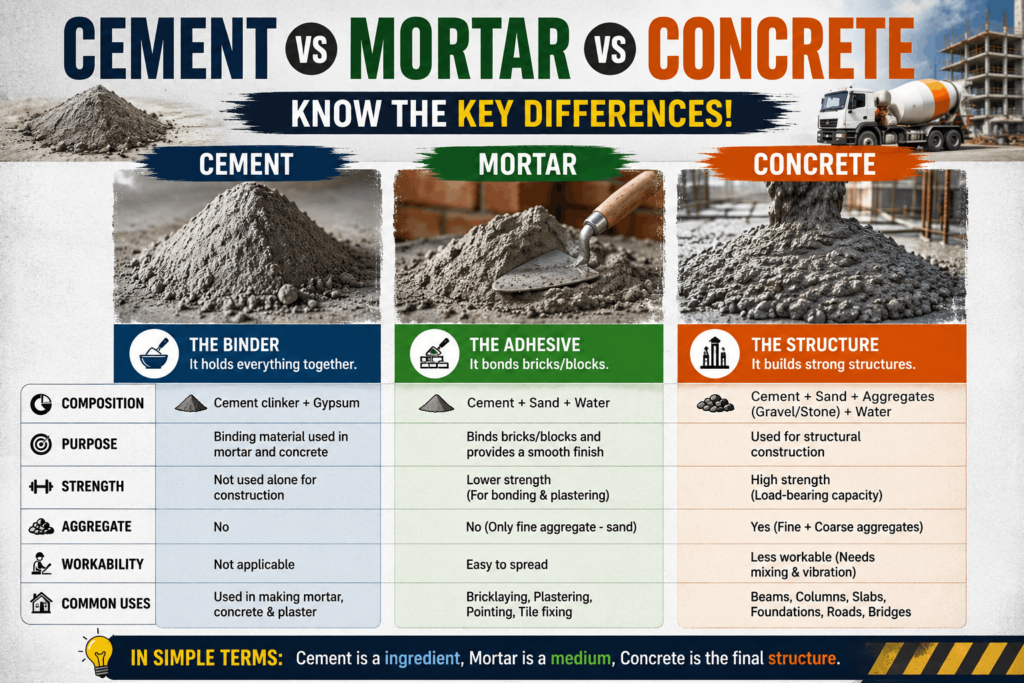
Common Differences between Cement, Mortar and Concrete?
Choosing Cement? Don’t Miss These 5 Key Factors
1. Cement Type
Choose the right cement based on your project requirements. OPC is ideal for high-strength structural work, while PPC and PSC offer better durability and resistance to environmental factors.
2. Strength & Grade
Check the cement grade (33, 43, or 53 Grade). Higher-grade cement generally provides greater compressive strength and is preferred for RCC structures, foundations, and high-rise buildings.
3. Durability & Weather Resistance
For coastal, humid, or chemically exposed environments, select cement with superior resistance to moisture, sulphates, and corrosion to ensure long-term structural durability.
4. Brand Reputation & Quality Certifications
Opt for trusted cement brands that comply with BIS standards and possess ISI certification. Established manufacturers typically maintain better quality control and consistency.
5. Price vs Performance
The cheapest cement is not always the best choice. Compare strength, durability, workability, and long-term performance alongside regional pricing to achieve the best value for your project.
Conclusion
Choosing the best cement in India is crucial for building durable, safe, and long-lasting structures. In 2026, brands like UltraTech Cement, Shree Cement, Ambuja Cement, and ACC continue to lead the market, offering quality, reliability, and value for money. Whether you’re an individual builder or a contractor, this guide helps you make a smart choice that balances price, performance, and strength. If you are looking to buy cement online in bulk, then the Moglix business is the one-stop solution for the best quality cement procurement at the most competitive prices.


 Back
Back