
What Are Transmission Towers? Types, Design, Voltage, Components, Everything Explained
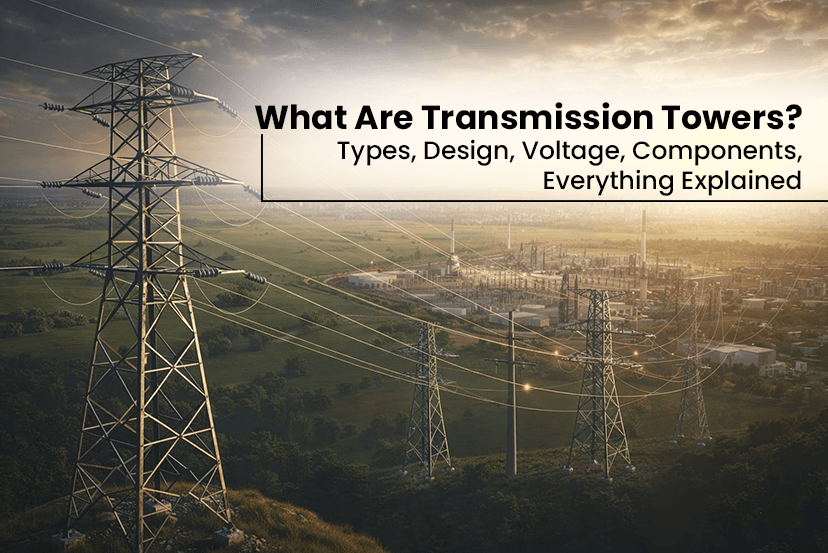
Transmission towers are one of the most critical infrastructures in the electrical power system. These tall steel structures support high-voltage overhead power lines and ensure safe and efficient transmission of electricity from power plants to substations and distribution networks. Without transmission towers, long-distance electricity transfer would be impossible. If you are planning to buy transmission towers in bulk at the most competitive prices, Moglix is the right platform to procure them efficiently.
In this complete guide, you’ll learn everything about transmission towers, including their types, design, voltage levels, components, functions, and applications.
What Are Transmission Towers?
A transmission tower (also called an electricity pylon or power tower) is a tall structure designed to carry overhead high-voltage power lines across long distances. These towers help maintain proper clearance from the ground, prevent electrical hazards, and support heavy conductors.
They are mainly used in power grids operated by organizations such as Power Grid Corporation of India Limited, which manages large-scale electricity transmission across India.
Purpose of Transmission Towers
Transmission towers serve several essential functions:
- Carry high-voltage power lines safely over long distances
- Maintain proper ground clearance
- Prevent short circuits and electrical faults
- Support insulators and conductors
- Ensure reliability of the power grid
Types of Transmission Towers
Transmission towers are classified based on structure, function, and voltage level.
1. Based on Structural Design
Suspension Towers
- Most common type
- Used for straight transmission routes
- Designed to support conductors without tension
Tension Towers
- Installed at turning points
- Handle the mechanical tension of conductors
- Used at river crossings or corners
Terminal Towers
- Located at the start and end of transmission lines
- Support heavy tension loads
2. Based on Shape
Lattice Towers
- Made of steel angles
- Most widely used design
- Strong and economical
Monopole Towers
- Single-pole structure
- Used in urban areas where space is limited
Guyed Towers
- Supported by tensioned cables
- Used for long spans
3. Based on Voltage Levels
Transmission towers are designed according to voltage rating:
| Voltage Level | Application |
| 11kV – 33kV | Local distribution |
| 66kV – 132kV | Regional transmission |
| 220kV – 400kV | High-capacity transmission |
| 765kV & above | Ultra high voltage transmission |
Higher voltage reduces power loss during long-distance transmission.
Components of Transmission Towers
Transmission towers consist of several important parts:
1. Foundation
- Supports the tower structure
- Made of reinforced concrete
2. Tower Body
- Steel lattice structure
- Provides strength and height
3. Cross Arms
- Hold the conductors in position
- Maintain spacing between wires
4. Insulators
- Prevent current leakage to the tower
- Usually made of porcelain or polymer
5. Conductors
- Aluminum or copper wires
- Carry electricity
6. Earth Wire (Shield Wire)
- Protects towers from lightning
Understand the Transmission Tower Design
Transmission towers are designed considering:
- Voltage level
- Wind load
- Weight of conductors
- Terrain conditions
- Environmental factors
Major engineering companies like Siemens and ABB contribute to advanced transmission tower technologies worldwide.
Materials Used in Transmission Towers
Common materials include:
- Galvanized steel (most common)
- Aluminum alloys
- Concrete (for monopoles)
- Composite materials
Galvanized steel is preferred because it offers high strength and corrosion resistance.
What are the Advantages of Transmission Towers
- Efficient long-distance power transmission
- Durable and weather-resistant
- High load-bearing capacity
- Low maintenance requirements
- Reliable power supply infrastructure
What are the Applications of Transmission Towers?
Transmission towers are widely used in:
- National power grids
- Renewable energy transmission
- Industrial power supply networks
- Rural electrification projects
- Urban high-voltage power lines
Future Trends in Transmission Towers
Modern innovations include:
- Smart monitoring systems
- Compact tower designs
- Corrosion-resistant materials
- High-voltage DC transmission towers
- Eco-friendly construction methods
Conclusion
Transmission towers play a vital role in delivering electricity from power generation stations to consumers safely and efficiently. Their design, type, voltage capacity, and components all contribute to reliable power transmission systems. As energy demand increases and renewable power expands, transmission tower technology continues to evolve with smarter, stronger, and more efficient designs. Moglix is the one-stop destination to buy transmission towers in bulk at the most competitive prices.


 Back
Back