
What Is AAC Block? Types, Uses, Features, and Importance
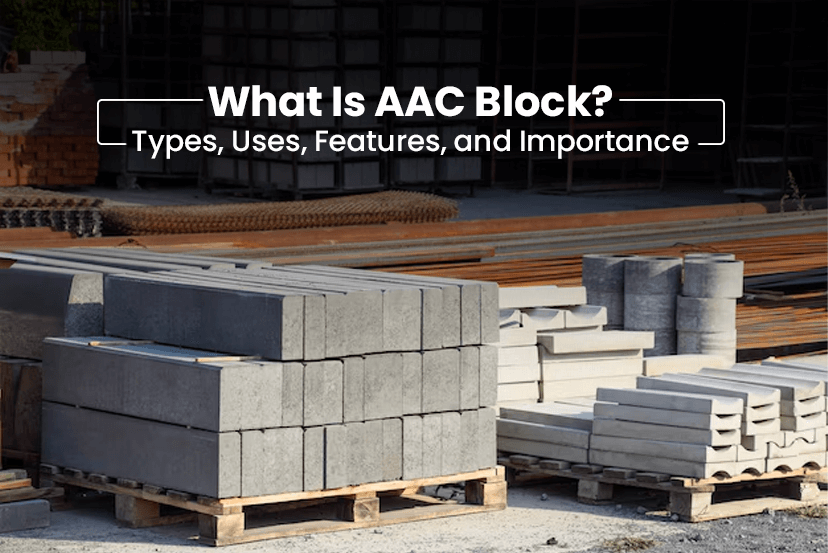
In modern construction, balancing strength, cost, speed, and sustainability is crucial. One building material that meets all these requirements is the AAC block. Widely used in residential, commercial, and industrial projects, AAC blocks have transformed the way walls are constructed in India and across the globe. This blog explains what AAC blocks are, their types, uses, features, and importance, helping you decide whether they are right for your next construction project.
What does an AAC Block mean?
AAC block full form is Autoclaved Aerated Concrete block, which is a lightweight precast building material made from cement, lime, fly ash, sand, water, and an expanding agent. Through a controlled manufacturing process and high-pressure steam curing (autoclaving), AAC blocks develop a porous, honeycomb-like structure that gives them high strength while keeping them extremely lightweight. Compared to traditional red bricks, AAC blocks are larger, lighter, more uniform, and offer better thermal and acoustic insulation.
How AAC Blocks Are Made?
- Raw materials such as cement, fly ash, lime, and sand are mixed.
- Aluminum powder is added to create air bubbles through a chemical reaction.
- The mixture expands and is cut into blocks or panels.
- The blocks are cured in an autoclave under high pressure and temperature.
- Final products are tested for strength, density, and quality.
Understand The Various Types Of AAC Blocks
AAC blocks are categorized based on density, size, and application:
1. Load-Bearing AAC Blocks
- Higher density and compressive strength
- Suitable for low-rise buildings
- Reduce the overall dead load on the structure
2. Non-Load-Bearing AAC Blocks
- Lower density
- Used for partition walls and infill walls
- Ideal for high-rise buildings with RCC frames
3. AAC Blocks Based on Density
- Low Density (400–500 kg/m³): Excellent insulation, used for partitions
- Medium Density (550–650 kg/m³): Commonly used for residential and commercial walls
- High Density (700 kg/m³ and above): Used where higher strength is required
4. AAC Panels (Advanced Type)
- Large, reinforced AAC panels
- Used for flooring, roofing, and cladding
- Speed up construction significantly
What Are The Uses Of AAC Blocks
AAC blocks are highly versatile and are used across various construction segments:
- Residential buildings – houses, apartments, villas
- Commercial structures – offices, malls, hotels
- Industrial buildings – warehouses, factories
- High-rise buildings – partition and infill walls
- Boundary walls and compound walls
- Fire-resistant walls and acoustic barriers
Have An Eye On The Key Features Of AAC Blocks
1. Lightweight Construction
AAC blocks weigh nearly one-third of traditional bricks, reducing structural load and foundation cost.
2. High Compressive Strength
Despite being light, AAC blocks offer sufficient strength for both load-bearing and non-load-bearing applications.
3. Excellent Thermal Insulation
The air pores in AAC blocks provide superior insulation, keeping buildings cooler in summer and warmer in winter.
4. Sound Insulation
AAC blocks effectively reduce noise, making them ideal for residential and commercial spaces.
5. Fire Resistance
AAC blocks are non-combustible and can withstand high temperatures for up to 4–6 hours, enhancing building safety.
6. Eco-Friendly Material
Manufactured using fly ash, a byproduct of thermal power plants, AAC blocks support sustainable construction.
7. Precise Dimensions
Uniform size and smooth surfaces reduce mortar usage and plaster thickness.
8. Faster Construction
Larger block size and easy handling speed up masonry work and reduce labor costs.
What Is an AAC Block Price Based on Sizes?
Here’s a quick breakdown of approximate per-piece rates for different thicknesses of AAC block (Autoclaved Aerated Concrete block) in India, though actual price may vary depending on region, brand, order quantity, and delivery charges:
- 4-inch AAC block: around ₹ 45 – ₹ 55 per piece.
- 6-inch AAC block: roughly ₹ 65 – ₹ 85 per piece.
- 8-inch AAC block: approximately ₹ 85 – ₹ 110 per piece.
Importance of AAC Blocks in Modern Construction
1. Cost Efficiency
Although AAC blocks may have a higher initial cost, they reduce expenses related to:
- Cement and mortar
- Steel consumption
- Plaster thickness
- Construction time
This makes the overall project more economical.
2. Structural Safety
Lower dead weight minimizes seismic impact, making AAC blocks suitable for earthquake-prone areas.
3. Energy Efficiency
Better insulation means reduced dependence on air conditioners and heaters, lowering long-term energy costs.
4. Sustainable Building Solution
AAC blocks contribute to green building certifications and help reduce carbon footprint.
5. Long-Term Durability
AAC blocks resist termites, mold, and moisture-related damage, ensuring a longer lifespan of structures.
AAC Blocks vs Red Bricks (Quick Comparison)
| Feature | AAC Blocks | Red Bricks |
| Weight | Very light | Heavy |
| Size | Large and uniform | Small and uneven |
| Thermal Insulation | Excellent | Limited |
| Construction Speed | Fast | Slow |
| Material Wastage | Minimal | High |
| Eco-Friendliness | High | Moderate |
Conclusion
AAC blocks have emerged as smart, sustainable, and cost-effective building materials for modern construction. With advantages like lightweight structure, excellent insulation, high fire resistance, and eco-friendliness, AAC blocks outperform traditional bricks in almost every aspect. Whether you are constructing a home, commercial complex, or industrial facility, you can buy AAC blocks at Moglix Business in bulk from reputed and trusted brands that offer long-term benefits in terms of safety, cost savings, and energy efficiency.


 Back
Back