
Grades of Corrosion-Resistant Stainless Steel: A Quick Guide 2026
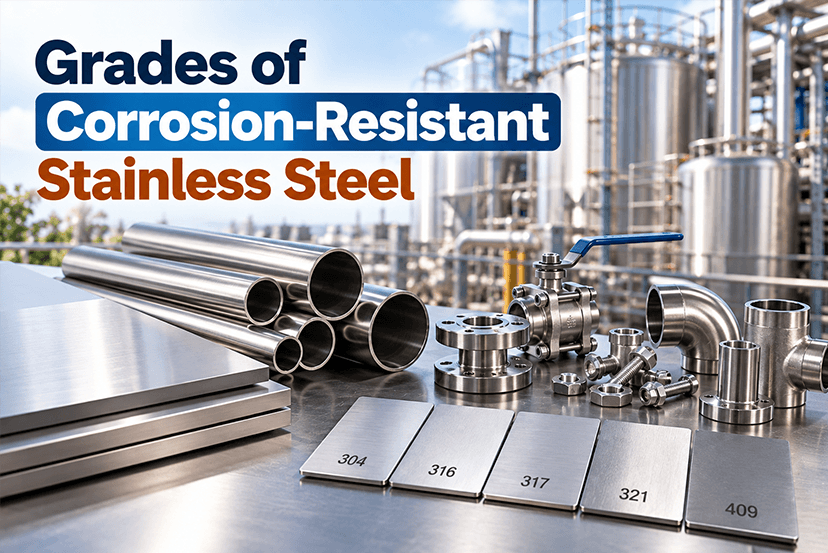
Stainless steel is widely used across construction, manufacturing, food processing, chemical processing, automotive, marine, and industrial applications because of its strength, durability, and resistance to corrosion. However, not all stainless steel grades offer the same level of corrosion resistance. The right grade depends on factors such as exposure to moisture, chemicals, salt, temperature, and mechanical stress.
Understanding the different corrosion-resistant stainless steel grades can help businesses, engineers, and buyers select the right material for their specific application. Popular options such as 304 stainless steel, 316 stainless steel, 321 stainless steel, 904L stainless steel, and duplex stainless steel offer different combinations of corrosion resistance, strength, temperature performance, and cost. If you are looking to procure various grades of stainless steel at wholesale prices, you can simply raise RFQs at Moglix Business and get the best prices.
This guide explains the major grades of corrosion-resistant stainless steel, their properties, applications, and how to choose the right grade.
What Is Corrosion-Resistant Stainless Steel?
Corrosion-resistant stainless steel is an iron-based alloy containing a minimum of about 10.5% chromium. Chromium reacts with oxygen to form a thin, passive oxide layer on the surface of the steel. This layer helps protect the underlying metal from rust and corrosion.
The corrosion resistance of stainless steel can be further improved by adding elements such as nickel, molybdenum, nitrogen, and titanium. Different combinations of these alloying elements create different stainless steel grades suitable for specific environments.
For example, 304 stainless steel is widely used for general-purpose corrosion resistance, while 316 stainless steel contains molybdenum and generally provides better resistance to chlorides and marine environments.
Why Do Stainless Steel Grades Differ in Corrosion Resistance?
The chemical composition and microstructure of stainless steel largely determine its corrosion resistance. Important alloying elements include:
- Chromium: Creates the passive protective layer that provides basic corrosion resistance.
- Nickel: Improves corrosion resistance, toughness, and formability.
- Molybdenum: Improves resistance to pitting and crevice corrosion, particularly in chloride-containing environments.
- Nitrogen: Can improve strength and resistance to certain forms of corrosion.
- Titanium: Helps stabilise certain grades and reduces the risk of sensitisation during high-temperature exposure.
Therefore, choosing a stainless steel grade should be based on the actual operating environment rather than corrosion resistance alone.
List of Common Corrosion-Resistant Stainless Steel Grades
1. 304 Stainless Steel
304 stainless steel is one of the most commonly used stainless steel grades. It generally contains chromium and nickel and provides good resistance to atmospheric corrosion, moisture, and many common chemicals.
It offers a useful combination of corrosion resistance, strength, weldability, formability, and relatively easy fabrication.
Key Features
- Good general corrosion resistance
- Excellent formability
- Good weldability
- Suitable for indoor and outdoor applications
- Easy to fabricate and maintain
Common Applications
304 stainless steel is commonly used for:
- Food processing equipment
- Kitchen equipment
- Storage tanks
- Pipes and fittings
- Fasteners
- Architectural applications
- Industrial equipment
For many general-purpose applications, 304 stainless steel is a practical corrosion-resistant material choice.
2. 316 Stainless Steel
316 stainless steel is a widely used corrosion-resistant grade when greater resistance to chlorides and aggressive environments is required. Its molybdenum content improves resistance to pitting and crevice corrosion compared with standard 304 stainless steel.
It is particularly useful in marine, chemical processing, pharmaceutical, and food-processing environments where exposure to corrosive substances may be higher.
Key Features
- High corrosion resistance
- Improved chloride resistance
- Good resistance to pitting
- Excellent weldability
- Good strength and durability
Common Applications
316 stainless steel is often used for:
- Marine equipment
- Chemical processing equipment
- Pharmaceutical equipment
- Food-processing machinery
- Heat exchangers
- Pumps and valves
- Outdoor industrial equipment
When selecting stainless steel for marine or chloride-rich environments, 316 is often considered because of its molybdenum addition.
3. 321 Stainless Steel
321 stainless steel is a titanium-stabilised austenitic stainless steel grade designed for applications involving elevated temperatures. Titanium helps reduce the risk of chromium carbide precipitation during heating and welding.
It combines corrosion resistance with good high-temperature performance.
Key Features
- Good corrosion resistance
- Excellent high-temperature performance
- Good weldability
- Resistant to intergranular corrosion after exposure to certain elevated temperatures
- Good mechanical properties
Common Applications
321 stainless steel is commonly used in:
- Aircraft components
- Exhaust systems
- Heat exchangers
- High-temperature processing equipment
- Chemical processing equipment
- Expansion joints
It is particularly useful where stainless steel components must withstand repeated or prolonged exposure to elevated temperatures.
4. 347 Stainless Steel
347 stainless steel is another stabilised austenitic grade. It uses niobium to improve resistance to intergranular corrosion following exposure to elevated temperatures.
It is suitable for applications where components experience high temperatures and require good corrosion resistance.
Common Applications
- Aerospace components
- Chemical processing equipment
- High-temperature piping
- Heat exchangers
- Industrial equipment
The choice between 321 and 347 stainless steel depends on the operating conditions, fabrication requirements, temperature exposure, and engineering specifications.
5. 904L Stainless Steel
904L stainless steel is a highly alloyed austenitic stainless steel designed for demanding corrosive environments. It contains relatively high levels of nickel, chromium, molybdenum, and copper.
These alloying elements provide strong resistance to several forms of corrosion, including corrosion in highly acidic environments.
Key Features
- Very high corrosion resistance
- Strong resistance to pitting and crevice corrosion
- Good resistance to sulfuric acid environments
- Good weldability
- Suitable for demanding chemical applications
Common Applications
904L stainless steel can be used in:
- Chemical processing
- Pharmaceutical equipment
- Acid-handling systems
- Heat exchangers
- Pollution-control equipment
- Industrial processing equipment
Because of its higher alloy content, 904L is generally selected for specialised applications where standard stainless steel grades may not provide sufficient corrosion resistance.
Duplex Stainless Steel
Duplex stainless steel combines characteristics of austenitic and ferritic stainless steels. Its mixed microstructure provides a combination of high strength and good corrosion resistance.
Duplex grades are particularly useful when applications require both mechanical strength and resistance to chloride-induced corrosion.
Key Features
- High mechanical strength
- Good resistance to chloride environments
- Good resistance to stress corrosion cracking
- Good resistance to pitting and crevice corrosion
- Suitable for demanding industrial applications
Common Applications
Duplex stainless steel is used in:
- Oil and gas equipment
- Chemical processing
- Marine applications
- Pressure vessels
- Heat exchangers
- Desalination equipment
- Industrial piping systems
Common duplex grades include 2205 duplex stainless steel and higher-alloyed super duplex grades.
Comparison of Popular Corrosion-Resistant Stainless Steel Grades
- 304 Stainless Steel: Best suited for general-purpose applications where good corrosion resistance, formability, and weldability are required.
- 316 Stainless Steel: Suitable for environments with greater exposure to chlorides, moisture, and marine conditions.
- 321 Stainless Steel: Useful for high-temperature applications where stabilisation against sensitisation is important.
- 347 Stainless Steel: Suitable for high-temperature applications requiring resistance to intergranular corrosion.
- 904L Stainless Steel: Designed for highly corrosive and chemically demanding environments.
- Duplex Stainless Steel: Suitable for applications requiring high strength along with strong resistance to chloride-related corrosion.
How to Choose the Right Corrosion-Resistant Stainless Steel Grade?
Selecting a stainless steel grade requires more than simply choosing the grade with the highest corrosion resistance. Consider the complete operating environment and application requirements.
1. Identify the Corrosive Environment
Determine whether the material will be exposed to:
- Fresh water
- Salt water
- Chlorides
- Acids
- Alkalis
- Industrial chemicals
- High humidity
- Atmospheric pollutants
The more aggressive the environment, the more important grade selection becomes.
2. Consider Operating Temperature
Temperature can influence both corrosion behaviour and mechanical properties. For high-temperature applications, grades such as 321 and 347 may be considered depending on the specific conditions.
3. Check Mechanical Requirements
Strength, hardness, toughness, pressure resistance, and fatigue performance should also be evaluated. Duplex stainless steels may be suitable where high strength is a major requirement.
4. Consider Welding and Fabrication
If the material needs extensive welding, bending, machining, or forming, choose a grade that meets the fabrication requirements. Austenitic stainless steels such as 304 and 316 are widely used because of their good fabrication characteristics.
5. Evaluate Cost and Service Life
A higher-alloy stainless steel grade can cost more initially, but the appropriate material may reduce maintenance, replacement, and downtime costs in demanding environments.
The goal should be to select the right stainless steel grade for the application, rather than simply choosing the most corrosion-resistant option.
Benefits of Using Corrosion-Resistant Stainless Steel
Using an appropriate corrosion-resistant stainless steel grade can provide several benefits:
- Long service life: Stainless steel can remain functional for extended periods when correctly selected and maintained.
- Lower maintenance: Resistance to corrosion can reduce frequent repair and replacement requirements.
- Good hygiene: Smooth stainless steel surfaces are widely used in food, pharmaceutical, and sanitary applications.
- High strength: Several stainless steel grades offer strong mechanical performance.
- Good fabrication: Many grades can be welded, formed, machined, and fabricated for industrial applications.
- Aesthetic appearance: Stainless steel offers a clean metallic finish for architectural and consumer applications.
- Recyclability: Stainless steel can be recycled at the end of its useful life.
Final Thoughts
Choosing the right corrosion-resistant stainless steel grade is important for improving equipment durability, reducing maintenance requirements, and achieving reliable performance in demanding environments. Grades such as 304, 316, 321, 347, 904L, and duplex stainless steel offer different combinations of corrosion resistance, strength, temperature performance, and fabrication characteristics.
Before purchasing stainless steel, evaluate the operating environment, chemical exposure, temperature, mechanical requirements, welding needs, and expected service life. Selecting the right grade based on these factors can help ensure better performance and long-term value.
Frequently Asked Questions
Which stainless steel grade has the best corrosion resistance?
The most suitable high-corrosion-resistance grade depends on the environment. Highly alloyed grades such as 904L and super duplex stainless steels are designed for demanding conditions, while 316 is commonly selected for many chloride-exposed applications.
Is 304 stainless steel corrosion resistant?
Yes. 304 stainless steel provides good resistance to many atmospheric and common corrosive environments and is widely used for general-purpose applications.
Is 316 stainless steel better than 304 for corrosion resistance?
316 generally provides better resistance to pitting and crevice corrosion in chloride-containing environments because it contains molybdenum. However, the appropriate grade depends on the specific application.
Which stainless steel is suitable for marine applications?
316 stainless steel is commonly used in marine environments because of its improved resistance to chloride-related corrosion. More demanding marine applications may require duplex or super duplex grades.
Does stainless steel completely prevent rust?
No. Stainless steel is corrosion resistant rather than completely corrosion-proof. Under certain conditions, including aggressive chemical exposure, high chloride concentrations, contamination, or poor maintenance, corrosion can occur.


 Back
Back