The Ganga Expressway Road Development Project: 5 Highlights

The Ganga Expressway Road Development Project: 5 Highlights

The 594 km long Ganga Expressway, a 6-lane wide (expandable to 8) expressway in Uttar Pradesh, will be the longest built under the DFBOT (design, finance, build, and operate) scheme. The expressway will connect Meerut to Prayagraj (erstwhile Allahabad).

A Gateway to the World-Famous Kumbh Mela:

The ambitious Ganga Expressway project was inaugurated in December 2021 and is expected to be completed in 2024. The expressway will run parallel alongside the river Ganga and connect the state’s west and east regions. It will pass through 12 districts of Uttar Pradesh, namely (from west to east), Meerut, Hapur, Bulandshahr, Amroha, Sambhal, Budaun, Shahjahanpur, Hardoi, Unnao, Raebareli, Pratapgarh and Prayagraj. It will connect Bijauli village near Kharkhauda on NH-334 in Meerut district with Judapur Dandu village near Soraon on NH-19 in Prayagraj district. 

A Stellar Addition to an Ever-Impressive List of National Infrastructure Projects (NIP) in India:

The project will be a shining example of infrastructure development in India after completing both phases. Two private contractors (IRB and Adani Group) have won the right to execute the expressway as per the bidding rights that the UPEIDA awarded. The expressway has had special environmental clearance granted to it and is expected to serve as an artificial barrier alongside the banks of the River Ganga. The transit freeway will protect the flood-affected area in the districts it traverses. 

Highway to Economic Inclusion and MSME Growth:

The Ganga Expressway project is a greenfield project estimated to be INR 36,000 crore in value, including land acquisition cost. It will cover 140 water bodies and have seven road overbridges, 17 interchange roads, 14 big bridges, 126 minor bridges, 28 flyovers, 50 vehicle underpasses, and 946 culverts. Suffice to say, the complexity in the procurement of raw materials across hundreds of suppliers is bound to increase the project complexity. 

With special environmental clearance granted to the project, the raw material specifications and criticality of timelines will play a significant role in the successful and profitable completion of the project. The expressway is expected to cut short the travel time from Delhi to Prayagraj by almost 50%, besides providing impetus to the logistics needs of the agro-belt in the included districts.

A Digital Procurement Solutions Approach for New-Age Contractors:

As one can imagine, a project of so many moving parts needs intense coordination in procurement and the supply chain of raw materials. A single missing link in the chain results in labor inefficiency, time delays and a bloated budget. Some key takeaways for contractors and suppliers to usher in a transformation in crucial infrastructure projects:

  • Adopt a flexible, reliable and digital procurement solution to reduce the PR to PO cycle. A slight reduction in the time cycle can have a lasting impact on costs. 
  • Digital procurement enables end-to-end flexibility and transparency of the procurement chain, involving many materials like TMT bars, cement plates and ready mix concrete. 

To know more about how an EPC solution can work for your construction or infrastructure project, reach out to Moglix. Explore the best raw material procurement solutions for infrastructure companies. Click here to know more: https://business.moglix.com/our-solutions/infrastructure

Infrastructure Makeover in Progress: Bundelkhand ExpressWay

Infrastructure Makeover in Progress: Bundelkhand ExpressWay

The 296 km long Bundelkhand Expressway is a 4-lane wide (expandable to 6) under-construction access-controlled expressway in Uttar Pradesh, India. It is the 4th currently under construction expressway in India’s most populous state.

An Expressway to a Significant Cultural and Pilgrimage Center, Chitrakoot:

While the state government of Uttar Pradesh announced the Bundelkhand expressway project in 2017, the foundation stone ceremony took place in February 2020 at the hands of the Hon. Prime Minister Shri Narendra Modi. Bundelkhand Expressway will pass through 7 districts of Uttar Pradesh, i.e. (from north to south) Etawah, Auraiya, Jalaun, Hamirpur, Mahoba, Banda and Chitrakoot.

A Stellar Addition to an Ever-Impressive List of National Infrastructure Projects (NIP) in India:

The ambitious project will run a distance of 296 km. Its construction cost is estimated to be around INR 7,766 crores. The construction work is divided into six packages and awarded to 4 different contractors who will construct 4 railway-over-bridges (ROB), 14 major bridges, 268 minor bridges, 18 flyovers, 6 Toll Plazas, 7 ramp plazas and 214 underpasses. The real value add of the expressway will be the boost it will give to the cultural and religious tourism in the districts while also connecting some of the state’s most underdeveloped communities to the bustling National Capital Region (NCR).

Paving the Road to a Fast-Tracked Infrastructure Ecosystem in India:

Being built under the auspices of the National Infrastructure Pipeline, the Bundelkhand Expressway follows the recent trend of large infrastructure projects awarded on an Engineering, Procurement and Construction (EPC) model. The design, construction and handover of the complete expressway thus become the end-to-end responsibility of the contractors. 

There are two significant challenges for contractors, suppliers and vendors associated with the project. First, the far-flung and underdeveloped nature of the districts represents logistical nightmares for a stable supply chain of raw materials. Second, the expressway is a critical element of the Defense Corridor development in Uttar Pradesh. Delays in construction translate to rising costs for the contractors and the government alike.

A Digital Procurement Solutions Approach for New-Age Contractors

As one can imagine, a project of so many moving parts needs intense coordination in procurement and the supply chain of raw materials, consumables, and made-to-order manufacturing solutions. A single missing link in the chain results in labor inefficiency, time delays and a bloated budget. Some key takeaways for EPC companies, contractors and suppliers to usher in a transformation in crucial infrastructure projects:

  • Adopt a flexible, reliable and digital procurement solution to reduce the PR to PO cycle. A slight reduction in the time cycle can have a lasting impact on costs. 
  • Digital procurement enables end-to-end flexibility and transparency of the procurement chain, involving many materials like TMT bars, cement plates and ready mix concrete.

To know more about how an EPC solution can work for your construction or infrastructure project, reach out to Moglix. Explore the best raw material procurement solutions for infrastructure companies. Click here to know more: ​​https://business.moglix.com/our-solutions/infrastructure

Building Infrastructure To Connect India`s Highways to the Global Supply Chain

Building Infrastructure To Connect India`s Highways to the Global Supply Chain

At 14 per cent, India has one of the highest logistics costs relative to GDP. Similarly, India’s power cost as a percentage of GDP is also among the highest in the world. This has limited the competitiveness of India’s products in the past. For India to be a manufacturing global superpower, infrastructure creation is the foundation.

By connecting India’s upcoming cities to better opportunities for domestic trade it will enable business continuity. Infra-building initiatives like the 100 Smart Cities Mission and the PLI scheme covering 13 sub-sectors will enable Indian manufacturing to widen its footprint into tier-2 and tier-3 cities. 

Infrastructure creation will enable small and large manufacturers in India to connect to EXIM trade opportunities. Robust infrastructure for EXIM trade such as airports, ports, inland container depots, and logistics parks will allow Indian manufacturing to leverage the untapped potential of MSME suppliers through greater local capacity utilisation. Infrastructure creation alone can contribute 4.5 per cent to India’s GDP growth rate every year. 

The lack of visibility into relevant metrics distorts the creditworthiness assessment of MSMEs and slows down the release of working capital. Agile cash flow is the fuel that India’s MSMEs need. A shift from offline to digital credit disbursal can strengthen MSMEs’ balance sheets. 

Digital supply chain financing platforms leverage dynamic metrics like cash flow to make credit approvals safer through more accurate underwriting and enable quick on-demand credit injection into MSMEs’ balance sheets. 

A switch from cash-based offline credit disbursal to digital supply chain financing can add three percent to India’s GDP every year. 

Digital transformation is the multiplier that will bring these together to work seamlessly for us and our partners across the world. The time to make India a manufacturing superpower and create a “community of shared destiny” is now.

B2B Commerce Unicorn Moglix raises $250 Million in Series F funding

B2B Commerce Unicorn Moglix raises $250 Million in Series F funding

Moglix, the industrial B2B startup for manufacturing and supply chain ecosystem, has raised $250 million in its latest Series F funding round, stands at a valuation of $2.6 billion. This round of investment was led by Tiger Global and Alpha Wave Global with Hong Kong based-investment firm Ward Ferry coming on board as a new investor.

Early investors, who had invested in Moglix during the seed stage have seen an 80X return on their investment in this B2B commerce firm. Moglix is one of India’s largest and fastest-growing B2B Commerce companies. It works with manufacturing and infrastructure companies to transform their end-to-end supply chain, from procurement to distribution. In May 2021, Moglix became the first B2B Commerce unicorn or a startup with over $1 billion valuation, in the manufacturing sector, raising $120 million.

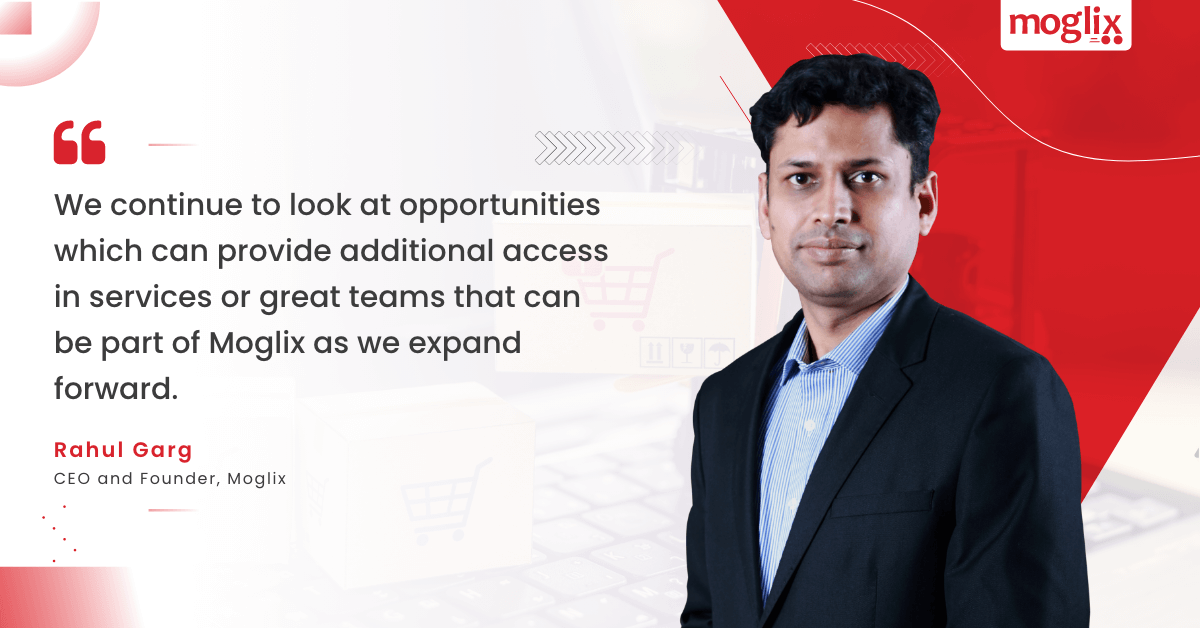
“We are happy to have the continued support and faith of our investors, customers, suppliers and team. We are excited to welcome Ward Ferry onboard. We are focused on our mission to enable the creation of a $1 trillion manufacturing ecosystem in India,”

Rahul Garg, CEO & Founder, Moglix

The firm is backed by marquee global investors such as Tiger Global, Alpha Wave Global, Sequoia, Accel Partners, International Finance Corporation and Harvard Management Company Industry stalwart. Also, Ratan Tata, Chairman Emeritus, Tata Sons had invested in the start-up in 2016. Leaders from the start-up and manufacturing communities such as Kalyan Krishnamurthy, Vikrampati Singhania, Shailesh Rao have been investors in Moglix.

Rahul Garg, CEO, Moglix: On A Mission To Impact 100 Million Lives By 2030

Rahul Garg, CEO, Moglix: On A Mission To Impact 100 Million Lives By 2030

Rahul Garg is raring to go. And he wants to do it quickly.

That’s why just a few months after his company Moglix became a unicorn, Garg set up the Mogli foundation, which will work with organizations to bring innovations in areas as diverse as health care, environment, and livelihood in the country. The idea came largely from his own experience in India’s fight with the second wave of Covid-19.

“We want to now become the front and centre of everything manufacturing, procurement, and everything related to supply chain finance”

Rahul Garg, Founder, Moglix

India’s e-commerce B2B market is currently pegged at $1.7 billion, according to a report by consultancy firm RedSeer. It is expected to grow at an 80 percent compound annual rate (CAGR) to reach $60 billion by 2025. By comparison, the B2C e-commerce market is currently worth some $18 billion and is expected to grow at 40 percent CAGR. The country’s offline B2B market itself was estimated to be worth some $700 billion in 2018-19.

“It’s still very early days and I think the idea is can we impact 100 million lives by 2030 in a positive manner across health care, environment, and livelihood,” Garg says. “We have realized there is a larger purpose and larger objective that you can, as an organization, have to create impact.” 

The company has already launched operations in the UAE, a market it is now bullish on. It works with over 500 global enterprises to streamline their procurement and supply chain at more than 3,000 plants across infrastructure, metals and mining, oil and gas, chemicals, pharma, auto, and FMCG, among others. In addition, it also boasts a supply chain network of over 16,000 suppliers and over 35 warehouses.

Strategic Acquisition, Expansion and Scaling Up: Moglix Growth Action Plan in line

Strategic Acquisition, Expansion and Scaling Up: Moglix Growth Action Plan in line

Business-to-business (B2B) commerce platform Moglix, which stormed into the unicorn club this year after raising fresh funding at a valuation of $1 billion, expects to breakeven in 18-24 months even as it looks to make acquisitions, expand its categories and double down on its Middle East business.

“We have found that while today on the consumer side there is a lot of capability to get lending access in a fast manner from many platforms, the same thing on the B2B side is missing,”

Rahul Garg said

We believe that India has a $150-200 billion worth of financing need in the B2B space and there is at least $30-50 billion worth of need unfulfilled today. If we execute it properly, we are looking at $2 billion to be disbursed annually as part of the platform in 12-18 months.

Talking about his international plan and expansion in UAE, he added

“We entered the Middle East two months back. We have a team and a warehouse there and we are doubling down in the region. On the one hand, we have shipped to more than 120 countries over the last six years. We were shipping pandemic PPE (personal protective equipment) supplies in more than 25 countries. The other dimension is how our full-stack solutions in India are applicable across emerging markets (and how do we take it there).”

Moglix grew at 3x plus over the last 18 months as a company. We continue to scale our offering across multiple categories and there is always the unpredictability of what happens in the next few months but we are on track to grow 2-3x in this financial year. We have provided liquidity during the last two fundraisers to our employees. We cover 25-30% of our employees as part of the ESOP plan. We are continuing to double down. We would have announced Rs 30-40 crore worth of ESOPs. In the last 12 months, we hired more than 500 people. We aim to hire 300-400 people in the next six months. We didn’t do any layoffs during the pandemic.

How Augmented and Virtual Reality is becoming the future of manufacturing?

How Augmented and Virtual Reality is becoming the future of manufacturing?

The applications of AR and VR in various strata of the manufacturing sector can help it grow out of time-consuming, redundant cycles of functioning. AR is bringing precision to production and empowering workers with state-of-the-art methods for efficiency and ease. Through personalised guidance, automated support,better monitoring and analysis of faults & flaws, this technology assists people in focusing on their work and having an eye for detail. The ability of new-age technologies such as AI, Big Data and IoT to make manufacturing smarter and more inventive has received a lot of attention in recent years. And today, the potential of AR for manufacturing is only beginning to be explored, signalling enormous potential. Because of the development of sophisticated technology, every critical activity previously carried out by a time-consuming, manual method is now automated, simplified and painless. It is yet too early to tell if AR and VR investments indicate a coming revolution that will forever change manufacturing as we know it or if early adopters are experimenting. In any case, virtual technology in production is no longer just hype.

Road to the low-cost transition to Net-Zero lies via Value Engineering

Road to the low-cost transition to Net-Zero lies via Value Engineering

The Glasgow Climate Pact has made it clear that there is a universal mandate to get to net-zero emissions. However, each country will have its own timelines and trajectories. Through their regulatory mandates, governments will start clearing out carbon content from the supply chain, making space for green alternatives. Manufacturers will have to roll out innovative solutions with speed and scale to cash in on the opportunities.

Supply chains are subject to the bullwhip effect, where changes and errors accumulated upstream keep amplifying as we travel downstream. The way to accommodate this characteristic of supply chains is to develop digital solutions which allow flexible reallocation of resources and costs in response to real-time carbon emissions.

Optimizing the logistics planning for the delivery of goods for every procurement and distribution transaction is the first step in reducing the carbon footprint. Businesses will have to leverage data to map critical paths, container capacities, and multiple modes of logistics and choose the least cost-green logistics options.

Why is Light-Emitting Cement the New Favorite with EPC Companies

Why is Light-Emitting Cement the New Favorite with EPC Companies

Source – thejupital.com (legend-lights-the-path

Can you picture your walls lighting your space without the need for any electricity? Have you ever considered how difficult it would be to drive and stroll on the roads at night if there are no street lights? Well, it’s time to accept that the technology for sustainable construction materials has advanced in ways we could never have predicted.

Each one of those points listed above is now possible with the advent of light-emitting cement. Light-emitting cement is a sustainable construction material that does not use power to illuminate highways, roads, bicycle lanes, or rooms (if used in construction projects). 

Dr Jose Carlos Rubio of the Michoacan University of Saint Nicholas of Hidalgo in Mexico created this groundbreaking cement. The goal of the study was to change the microstructure of cement so that it could absorb solar energy and emit light in the dark. 

The phosphorescent materials collect energy from the sun, light from lights or lamps while indoors, and then glow during the dark hours. The cement is said to be able to shine for 12 hours even on cloudy days since the substance gets energised every day with ultraviolet radiation.

Since the gel is formed of sand, dust, clay, and water, it is clean and renewable. Due to the general inorganic nature of the cement components, the material is expected to last for 100 years. 

In comparison to existing phosphorescent materials such as plastics or paints, which degrade over time due to UV rays, this novel material is sun-resistant and more lasting. The total carbon footprint of this product is also potentially lower than regular cement. This means there is the potential to save a lot in maintenance costs as lower than contemporary cement. 

Engineering, Procurement and Construction (or EPC companies) are turning to unique and sustainable materials for infrastructure development. These sustainable construction materials fit in well with the guidelines outlined within the National Infrastructure Pipeline. 

The National Infrastructure Pipeline, or NIP, which will run from 2019 to 2025, is a “first-of-its-kind, whole-of-government effort to offer world-class infrastructure to citizens and improve their quality of life.” Both economic and social infrastructure projects are included by the NIP.

Several countries have expressed interest in light-emitting cement, indicating that there is a commercial need for the material. The research is now being carried out in order to go to the commercialization stage. 

The use of light-emitting cement in plaster and other construction materials is also under investigation. It is no wonder that light-emitting cement is now slowly becoming a new part of construction supply chains.

In an interesting application of this cement, after a trial of three months, Netherlands is one of the first to showcase their Glowing Lines project. It is claimed that their roads glow up to eight hours at night. The project is a collaboration between Roosegaarde and Heijmans and is a true example of an innovative industry. 

For more information on how Moglix can help you with supply chain solutions for infra companies visit https://business.moglix.com/our-solutions/infrastructure

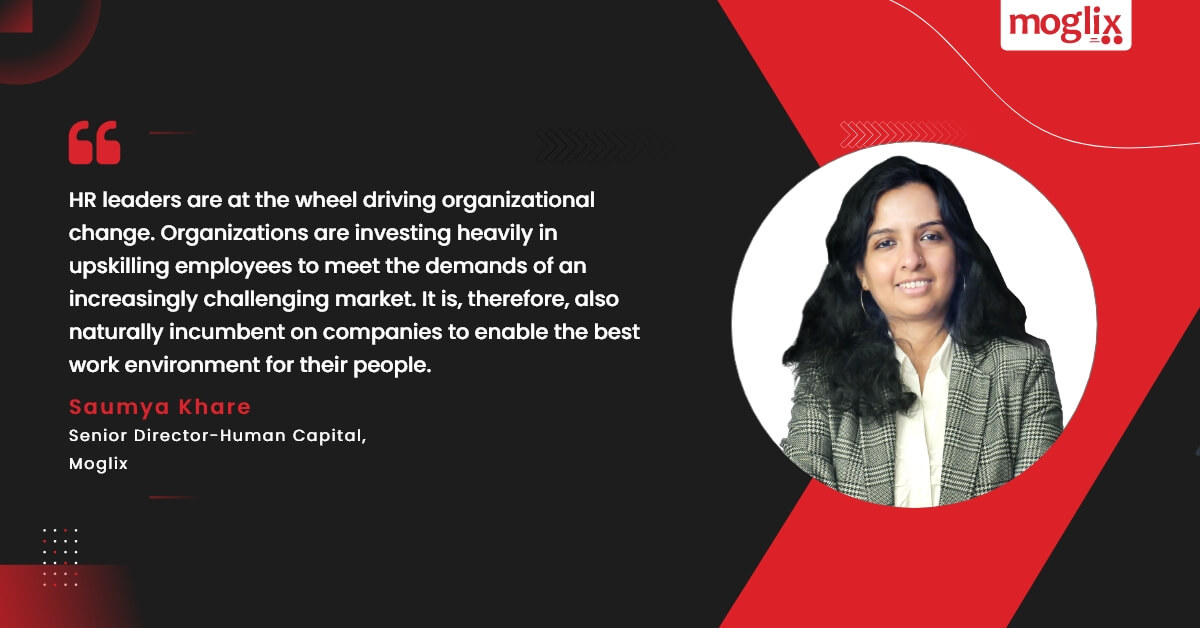
Unicorn HR leader, Saumya Khare, talks about hiring trends and careers opportunities with startups

Unicorn HR leader, Saumya Khare, talks about hiring trends and careers opportunities with startups

Moglix is a technology-first company. The technology industry respects innovation and innovation at scale mandates skill over and above experience. As pioneers of digital supply chain transformation in India, we believe in challenging the status quo, conducting controlled experiments to explore new solutions that did not exist before. The skill set that our people  bring to the table is critical to our capabilities to bring new ideas, new products, and new solutions for the manufacturing supply chain.

Startups have been at the forefront of the new economy, creating tremendous value, creating some of the most amazingly useful and efficient solutions that have saved lives and livelihood of people. Starting your career at a start-up is an accelerator. 

While answering to the audience Saumya said

“To understand if a startup will scale up or not, you will have to go beyond the cosmetics and understand the business model. That will help you make an informed choice. All founders want their startups to scale and that is why they are passionate about building it from ground level. Ultimately, you need to judge if you are convinced about the business model & potential and it is aligned with your skill sets”

In the technology industry, new waves of innovation continuously shape the dynamics of who stands where.

To summarize she said “startups offer fantastic opportunities for learning, empowerment while working, opportunities to work in different segments of interest and a very fast paced environment where you can see the direct impact of your work, & are just not a cog in the wheel”